
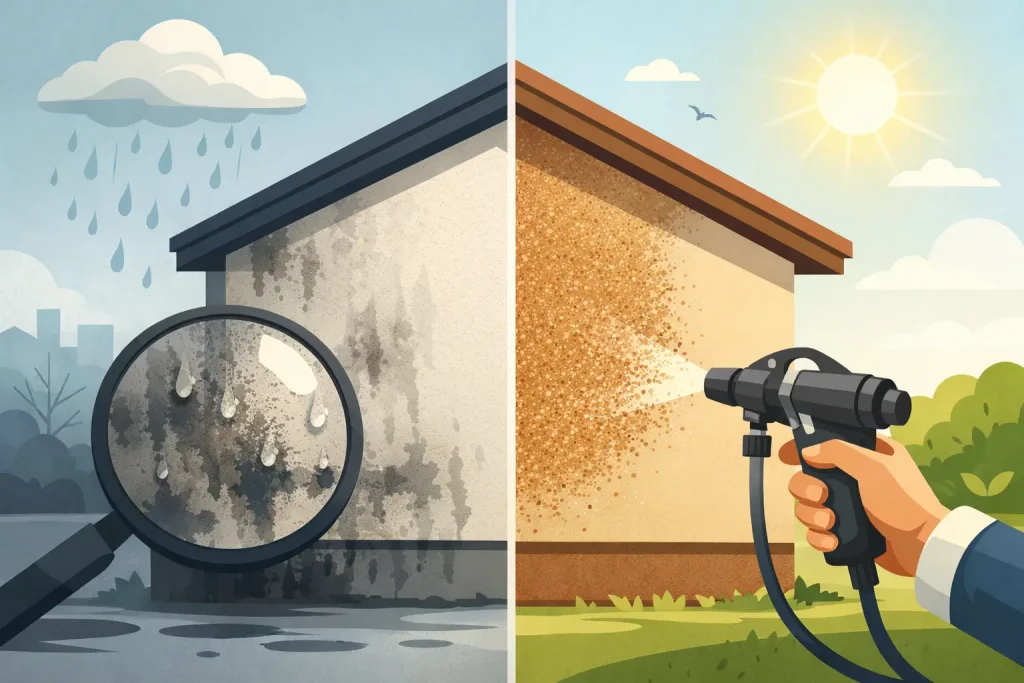
A damp patch that appears after heavy rain is rarely just a cosmetic issue. Paint may blister, plaster can soften and dark marks can keep returning because water is getting into the wall from outside. So, can cork spray reduce damp? It can help in the right circumstances, particularly where rain is penetrating through tired, cracked or porous external render. It is not, however, a cure for every type of damp.
The difference matters. Applying any external finish before finding the source of the moisture can leave a homeowner with a neater-looking wall and the same underlying problem. A proper assessment should come first.
When cork spray can reduce damp
Cork spray is an external coating made with natural cork granules and specialist binders. Once professionally applied, it forms a continuous, flexible finish across the outside of the property. Its main value in damp prevention is its ability to improve resistance to wind-driven rain while remaining breathable.
Traditional render can develop fine cracks over time. These may be small enough to miss from ground level, but repeated rainfall can force water through them. Older render can also become porous, particularly on exposed elevations, around window openings and beneath sills. Water entering at these points may show internally as staining, peeling paint or a cold, damp-feeling area of wall.
A properly prepared cork spray finish can reduce the amount of rainwater reaching the masonry or existing sound render beneath it. Its flexibility is useful because external walls move slightly with seasonal temperature changes. A rigid finish that has already cracked is more likely to let water in again; a flexible coating is better able to accommodate minor movement.
The coating can also help improve the surface warmth of an external wall. That does not make it a substitute for a full insulation system where one is needed, but it can make a difference to cold external surfaces. A warmer internal wall is less likely to attract condensation in borderline areas.
The type of damp makes all the difference
The word ‘damp’ covers several different problems. Cork spray is most relevant where the issue is penetrating damp from rain. It will not correct moisture that is rising from the ground, condensation caused by poor ventilation, a leaking pipe, or water coming in through a defective roof, gutter or window.
Penetrating damp
This is the situation in which cork spray may be a sensible part of the solution. Signs can include patches that worsen after rainfall, moss or staining on the external wall, cracked render, failed sealant around openings, or internal marks that line up with an obvious defect outside.
Before applying a new finish, the wall needs to be checked carefully. Loose or hollow render, open cracks, failed pointing, defective flashings and overflowing gutters all need attention. Cork spray is designed to protect a prepared surface, not hide faults that are still allowing water behind it.
Condensation
Condensation usually appears where warm, moisture-laden air meets a cold surface. It is common in bedrooms, bathrooms, kitchens and behind furniture placed tightly against outside walls. Black mould around window reveals, in corners or behind wardrobes is often a stronger clue for condensation than rain penetration.
Cork spray may help reduce a cold-wall effect, but it will not deal with excessive moisture in the home. Extractor fans, regular background ventilation, sensible heating and allowing air to circulate around furniture remain essential. If the wall is dry outside and the marks are appearing during colder months, ventilation should be considered before assuming the render is at fault.
Rising damp and bridging
Moisture at the base of a ground-floor wall needs a different investigation. High external ground levels, soil piled against the wall, blocked air bricks and paths that bridge protective details can all contribute to moisture problems. An external coating above this area does not remove the cause.
The same applies to internal plumbing leaks. If a patch stays wet during dry weather and does not relate to the condition of the external elevation, there may be another source. A reliable contractor should be clear about this rather than promising that one coating will solve everything.
Why breathability matters on older properties
A wall needs to manage moisture sensibly. Rain should be kept out, while small amounts of water vapour within the building fabric should be able to escape. If a finish traps moisture that is already in the wall, it can contribute to peeling, staining or frost damage over time.
This is one reason material choice and preparation matter. Cork spray systems are often selected for their vapour-permeable qualities alongside their resistance to rain. That balance can be particularly useful on solid-wall homes, where the wall construction differs from a modern cavity wall.
Still, breathability is not a licence to coat a wet wall. The substrate needs to be suitably dry, stable and free from defects before work starts. Any system should be chosen to suit the building and applied in line with the manufacturer’s requirements.
What a proper site assessment should cover
No one can diagnose a damp problem properly from a photograph alone. The location of the patch, the direction of the wall, the age and construction of the property, and the condition of gutters and render all affect the answer.
A useful inspection looks at the external elevation as well as the room inside. It should consider whether the wall is exposed to prevailing weather, whether cracks are active or superficial, and whether moisture marks correspond with rainwater goods, chimney details, window openings or ground levels. The condition of existing render is equally important. If it is loose or badly deteriorated, repairs or removal may be necessary before a new finish can be applied.
At Lee Crane Plastering incorporating Eco Corkspray Solutions, this practical approach matters. The aim is to identify whether cork spray is the right finish for the wall, not to apply it where a different repair is needed.
Preparing the wall is as important as the coating
The quality of the finished surface depends heavily on the work underneath it. Dirt, algae, loose paint and unstable render can prevent proper adhesion. Cracks need suitable repair, and details around pipes, windows, doors and junctions need careful treatment. These are common weak points for water ingress.
Weather conditions also matter. External coatings should not be applied during unsuitable rain, frost or extreme temperatures. Rushing an exterior job to meet a date can compromise the finish and its performance. A professional installation allows for correct preparation, drying times and consistent application across the elevation.
Colour and texture are worth considering too. Cork spray offers a textured finish that can refresh a dated property without the hard, flat appearance of some conventional render systems. But appearance should remain secondary to dealing with water entry and ensuring the substrate is sound.
Questions to ask before choosing cork spray
If you are considering cork spray because of an internal damp patch, start with a few straightforward questions. Does the patch become worse after wind and rain? Are there visible cracks or defects on the outside wall? Is the issue localised around a window, gutter, chimney or roofline? Or is mould appearing in rooms where moisture and poor airflow are likely factors?
It is also worth asking what condition the existing render is in and whether repairs are included in the proposed work. A quote should explain the preparation involved, the areas being treated and any faults that need resolving separately. Clear answers at this stage help avoid surprises once work begins.
Cork spray can be a worthwhile upgrade where external walls are letting in rain and the underlying surface has been properly repaired. Where the cause is condensation, leaking rainwater goods or moisture at low level, the best result comes from fixing that cause first. A careful inspection gives you a sound basis for deciding what your walls actually need.