
A newly plastered room can transform a property, but the method behind that clean, flat finish makes a real difference. When weighing up plasterboard versus wet plaster, the right choice depends on the condition of the walls, the room’s use, the timescale and the standard of finish required. There is no single answer for every house or refurbishment.
For many homeowners, the decision comes up after removing dated artex, opening up a room, repairing damaged ceilings or renovating a rental property between tenancies. Both methods can produce excellent results when specified properly and carried out by an experienced plasterer. The mistake is assuming they are interchangeable.
What is plasterboard?
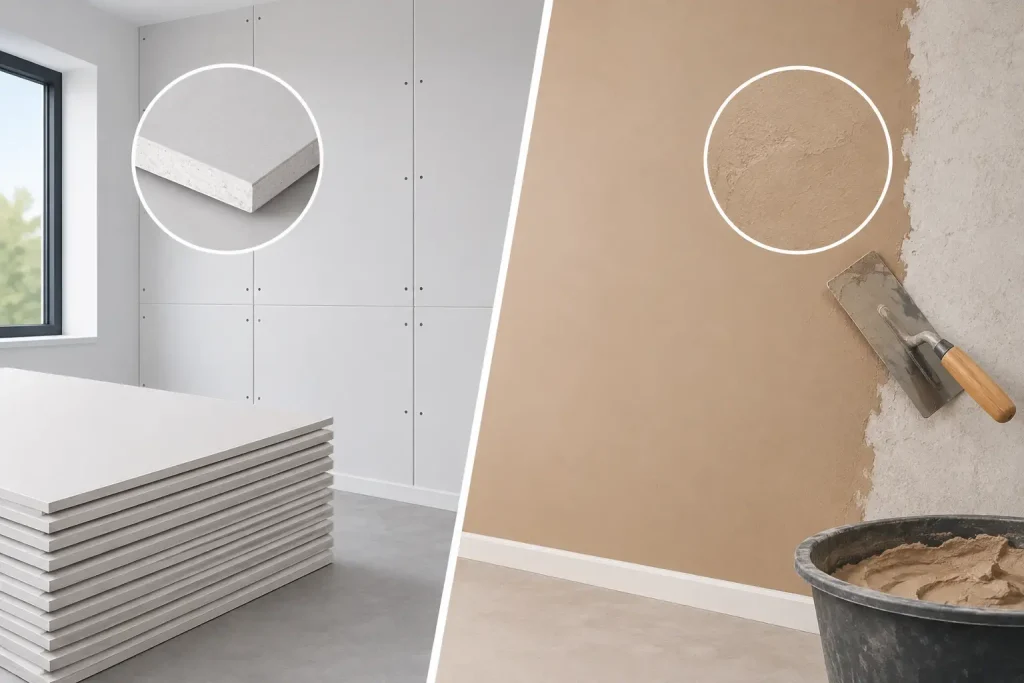
Plasterboard is a factory-made gypsum board fixed to a timber or metal stud framework, or attached directly to a suitable masonry wall using adhesive dabs. Joints are taped and filled, or the boards can be finished with a thin skim coat of plaster.
It is commonly used for new stud walls, ceiling replacements, loft conversions and areas where the existing background is too uneven or damaged to plaster directly. A board can also cover old finishes without the extensive preparation that a traditional plastered finish may require.
The main attraction is speed. Once the framework is in place or the background has been prepared, large areas can be boarded relatively quickly. It creates a straight, predictable surface and can make an awkward room easier to bring back into shape.
That said, fitting boards well still takes care. Poorly fixed boards, uneven adhesive dabs, badly placed joints or weak edges can lead to cracking, movement and an untidy finish later on. Boarding is not simply a shortcut. The setting out and preparation matter just as much as the final skim.
What is wet plaster?
Wet plaster is applied directly to a prepared wall or ceiling in coats. Depending on the surface and the repair required, this may involve a backing coat followed by a fine finish coat, or a skim finish over an existing sound plastered surface.
This method has long been used in UK homes because it allows a skilled plasterer to correct minor irregularities and leave walls and ceilings smooth, solid and ready for decoration. It is particularly useful where original masonry walls need repairing rather than covering, or where a room needs careful blending around existing features.
Wet plaster takes more time to apply and dry than boarding, but it gives the tradesperson greater control over the finished plane of the wall. On older properties, where walls can be far from straight, that control is often valuable.
Plasterboard versus wet plaster: finish quality
Both systems can look excellent. A properly skimmed plasterboard wall and a properly wet-plastered wall should both provide a smooth surface for painting or wallpapering. In either case, the quality comes down to the preparation, the materials and the person applying the finish.
Wet plaster can be the better option where walls require local repairs, corners need rebuilding or surfaces need bringing back into line without losing too much room space. It can follow the character of an existing room while still creating a clean, durable finish.
Plasterboard is often preferable where a wall is badly uneven, heavily cracked or covered in a surface that would take significant labour to prepare. It gives a fresh background to work from. When boarded walls are skimmed, the final appearance can be every bit as sharp as a wet-plastered surface.
If a customer asks for the flattest possible finish, it is worth looking beyond the method alone. Lighting can reveal every small imperfection, particularly along ceilings, stairwells and walls with large windows. Good workmanship includes checking the surface from different angles, protecting corners and leaving a finish that is ready for the decorator.
Drying time and programme of works
This is where the practical differences become clear. Plasterboard can help keep a refurbishment moving because the boards themselves do not need drying in the way wet-applied plaster does. If joints are tape-and-filled, decoration may be possible sooner, provided the filler has dried and been sanded correctly.
If plasterboard is skimmed, the skim coat still needs proper drying time before painting. Drying conditions vary greatly. Cold weather, poor ventilation, thick applications and damp backgrounds all slow the process. Rushing paint onto plaster that has not dried properly risks patchiness, poor adhesion and further decorating work.
Wet plaster naturally contains more moisture, so it generally needs longer before decorating. A room should be ventilated sensibly and allowed to dry at its own pace. Turning the heating up excessively or trying to force the process can cause problems rather than solve them.
For a landlord working to a tight turnaround, boarding may be attractive. For a homeowner renovating an older room where the walls need careful restoration, allowing time for wet plaster may be the better long-term decision. The programme should be planned around the finish, not the other way round.
Durability and everyday use
A solid wet-plastered wall can be very hard-wearing, particularly where the underlying surface is sound. It is a good choice for many internal masonry walls and for repairs that need to merge neatly with existing plaster.
Plasterboard performs well in most domestic spaces, but it is generally more vulnerable to a sharp impact than a solid plastered background. This matters in busy hallways, commercial areas, children’s rooms and places where furniture is regularly moved. Heavy items also need the right fixings, ideally into studs, noggins or a solid background rather than relying on the board alone.
Moisture is another consideration. Standard plasterboard is not suitable for every setting. Kitchens, bathrooms and utility rooms may require moisture-resistant boards and appropriate preparation, while surfaces close to heat sources need materials chosen for that purpose. This is not an area for guesswork.
Cost: look beyond the first quote
Plasterboard is often seen as the cheaper route, but the overall cost depends on the job. Boarding may reduce preparation time on a poor wall, yet it can involve timber or metal framing, insulation, fixings, beads, jointing and skimming. It may also reduce the room size slightly if a framework is required.
Wet plaster may involve more labour where walls need substantial preparation, repairs or multiple coats. However, for a sound wall that only needs patching and skimming, it can be the more sensible and economical option. Covering a surface that could be repaired properly is not always good value.
A reliable quotation should explain what is being done to the existing surface, what finish is included and whether areas will be skimmed, boarded, repaired or fully replaced. It should also account for protecting the room and leaving it clean at the end of the job. The lowest figure is rarely useful if it leaves essential preparation out of the scope.
When plasterboard makes most sense
Plasterboard is usually a strong choice for new internal partitions, replacement ceilings, converted spaces and walls that are too damaged or uneven to treat efficiently. It can also create a useful void for insulation or services where a stud framework is being built.
It is particularly practical when speed and straight lines are priorities, provided the loss of a small amount of floor space is acceptable. A skimmed board finish is often the preferred choice where homeowners want the look and feel of a traditionally plastered room with a more predictable background.
When wet plaster is the better answer
Wet plaster is often the right approach for sound existing walls, local damage, cracks around openings and rooms where keeping the original dimensions matters. It is also well suited to ceilings and walls that need skilled levelling and blending rather than covering over.
The key question is whether the existing surface is stable. Loose, hollow or moisture-damaged plaster should not simply be skimmed and hoped for the best. A proper inspection identifies whether repairs will hold, whether failed areas need removing and whether boarding would give a more dependable result.
At Lee Crane Plastering, the focus is on choosing the method that suits the surface rather than forcing every job into the same solution. A site assessment makes it possible to see what is actually behind the cracks, stains or uneven finish and advise accordingly.
Before deciding, consider how the room will be used, how quickly it needs to be decorated and whether the existing walls are worth repairing. A professional finish begins with making the right call on the background, then giving the work the time and care it deserves.