
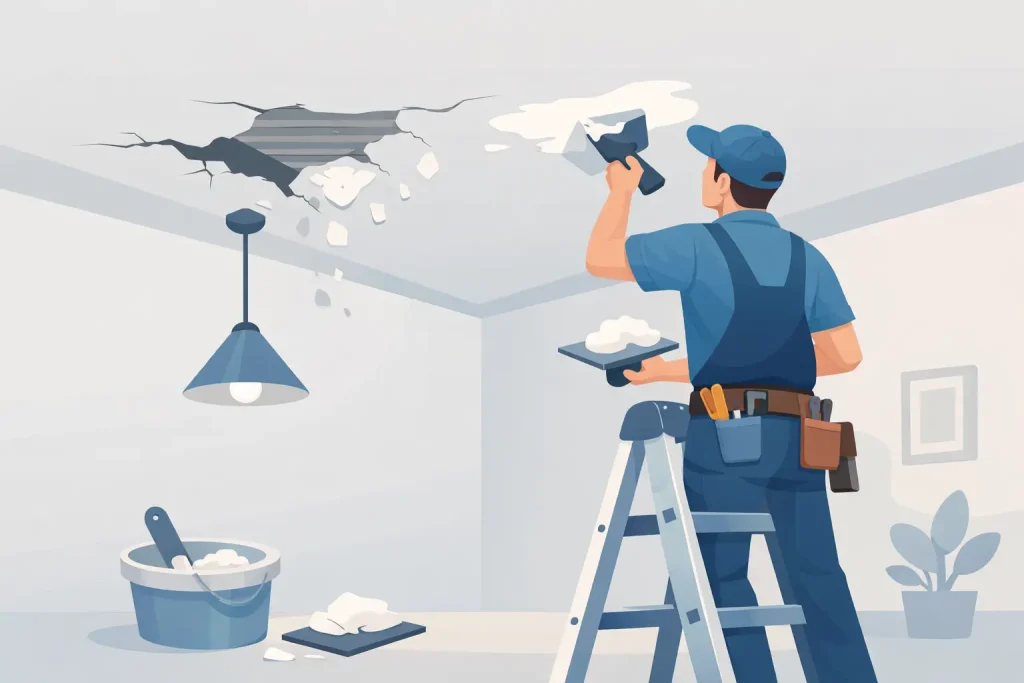
A crack running across the ceiling is easy to ignore for a while. Then the paint starts lifting, a stained patch spreads, or a small hollow sound turns into a section that feels loose overhead. At that point, the question becomes very practical: can a plaster ceiling be repaired, or does it need replacing altogether?
In many cases, yes, a plaster ceiling can be repaired. The right answer depends on what has failed, how far the damage has spread, and whether the original plaster is still sound enough to hold a proper repair. Some ceilings need little more than localised filling and re-skimming. Others are too loose, too cracked or too water-damaged to trust and are better taken down and renewed.
When can a plaster ceiling be repaired?
A plaster ceiling is usually repairable when the problem is isolated and the background is still firm. Hairline cracks, small areas of blown plaster, minor staining after a leak has been fixed, or patch damage from previous electrical or plumbing work can often be dealt with successfully.
What matters is not just what you can see on the surface. A ceiling might show a crack that looks minor, but if the plaster has lost its key and is starting to pull away from the laths or backing, the issue is more than cosmetic. On the other hand, a messy-looking ceiling may still be structurally stable and respond well to proper preparation and skimming.
This is where experience counts. A good plasterer will not just patch the visible mark and hope for the best. They will check whether the surrounding area is solid, whether movement is ongoing, and whether the finish can be blended in without leaving obvious high or low spots.
Signs your ceiling may only need repair
If the crack is fine and not widening, repair is often straightforward. The same applies where there is a small local hole, slight surface crazing, or a limited section that sounds slightly hollow but has not dropped or bowed.
You may also be dealing with old repairs that have failed because the preparation was poor rather than because the ceiling itself is beyond saving. We see this quite often in older properties, where someone has filled over movement cracks without opening them up properly or has painted over damaged plaster before it was dry and stable.
A repair is usually a realistic option when:
- the damaged area is limited rather than spread across the whole room
- the ceiling is flat and not sagging
- there are no signs of active water ingress
- the surrounding plaster remains firmly bonded
- any movement causing the crack has already been dealt with
Where those conditions are met, a repair can leave the ceiling looking clean, even and ready for decorating.
When repair is not enough
There are ceilings that should not simply be patched. If the plaster is coming away in multiple areas, bowing between joists, or showing long recurring cracks that reopen after filling, a more extensive solution is normally the safer choice.
Water damage is another common turning point. A ceiling that has been soaked may dry out on the surface while the bond underneath has already failed. Staining alone is not always a disaster, but softness, crumbling edges, sagging or bulging are all warning signs. In those cases, trying to save it can end up costing more if sections come down later.
The same applies if the ceiling has been heavily overworked over the years. Layers of textured coating, repeated patching, and uneven previous skims can leave too poor a base for a tidy long-term repair. Sometimes overboarding and skimming gives a far better finish than chasing one patch after another.
Can a plaster ceiling be repaired after a leak?
Yes, but only after the source of the leak has been fixed and the ceiling has fully dried. This is where many repairs go wrong. If moisture is still present, or if damaged material has not been removed back to firm edges, the new work will not last.
After a leak, the repair could be as simple as stain treatment and re-skimming, or as involved as cutting out failed sections and reinstating them. It depends on how badly the plaster has been affected. A brown water mark does not automatically mean full replacement. A swollen, cracked or sagging patch often does.
The key point is not to rush it. Drying time matters, and so does checking whether timbers, fixings or adjacent plaster have also been affected.
How a proper plaster ceiling repair is usually done
The method depends on the fault, but the general approach is consistent. First, any loose or hollow material is removed. Cracks are opened up where needed rather than skimmed over blindly. Dust and weak edges are cleaned back, and the area is stabilised so the new plaster has a sound base.
For smaller defects, that may mean filling and blending before a skim. For larger damaged sections, it may involve cutting out and patching with fresh board or backing plaster, then finishing the whole affected area to achieve a uniform surface.
The final finish matters as much as the repair itself. A ceiling catches light differently from a wall, especially in rooms with large windows or spotlights. If the work is not kept flat and consistent, every trowel mark and edge can show up once painted. That is why ceiling repairs need a careful hand, not just filler and a quick sand.
Repair or overboard?
This is often the real decision. A lot of customers ask whether it is better to repair the original ceiling or overboard and skim it. There is no single answer. If the existing ceiling is basically sound and the damage is limited, repair usually makes sense and avoids unnecessary disruption.
If cracks are widespread, the surface is uneven, or there is doubt about how well the old plaster is holding, overboarding can be the better route. It creates a fresh, stable surface and often gives a sharper final result. The trade-off is that it is more involved and may affect details such as coving, light fittings or ceiling height very slightly.
A straightforward site assessment usually makes the choice clearer. The best option is the one that leaves you with a ceiling you do not have to worry about again in six months.
What causes plaster ceilings to fail?
Age is one factor, especially in older homes where materials have been through years of seasonal movement. Small settlement cracks are common and not always serious. More troublesome problems come from water ingress, vibration, poor previous repairs, or loss of bond between the plaster and its background.
Sometimes the issue is hidden until decorating starts. Stripping wallpaper or scraping textured finishes can reveal weak patches that were only just hanging on. In other cases, damage comes from above, such as foot traffic in a loft, plumbing work, or movement around joists.
Knowing the cause matters because a ceiling repaired without addressing the reason for failure is far more likely to crack again.
Is it safe to leave a damaged plaster ceiling?
That depends on the type of damage. A fine crack is usually more of a finish issue than a safety concern. A sagging ceiling, loose plaster, or sections that sound very hollow overhead should not be ignored.
If pieces are already falling away, or the ceiling looks bowed, it needs checking promptly. What starts as a repairable section can become a much bigger job if it is left until more of the ceiling gives way. Safety comes first, especially in hallways, bedrooms and living areas where people are regularly underneath.
Can you repair a plaster ceiling yourself?
Very small cosmetic filling jobs are one thing. A proper ceiling repair is another. Working overhead is awkward, preparation is easy to underestimate, and a poor repair tends to stand out badly once the light hits it.
The bigger risk is misjudging what is actually loose. A surface that seems sound to a homeowner can be hollow well beyond the visible crack. If you skim or fill over that, the finish may fail again quite quickly.
For anything beyond the smallest superficial blemish, it is usually worth getting a professional opinion. A reliable plasterer should be able to tell you plainly whether the ceiling can be repaired, whether part of it needs replacing, or whether overboarding would be the better long-term fix.
Getting the right result
So, can a plaster ceiling be repaired? In many cases, yes. The important part is choosing the repair that suits the actual condition of the ceiling, not just the mark you can see from the floor.
A sound repair should leave the ceiling flat, secure and ready to decorate, not patched up in a way that keeps drawing your eye every time the light changes. If you are unsure whether your ceiling needs a local repair or more extensive work, getting it looked at early is often the simplest way to avoid a bigger job later.