
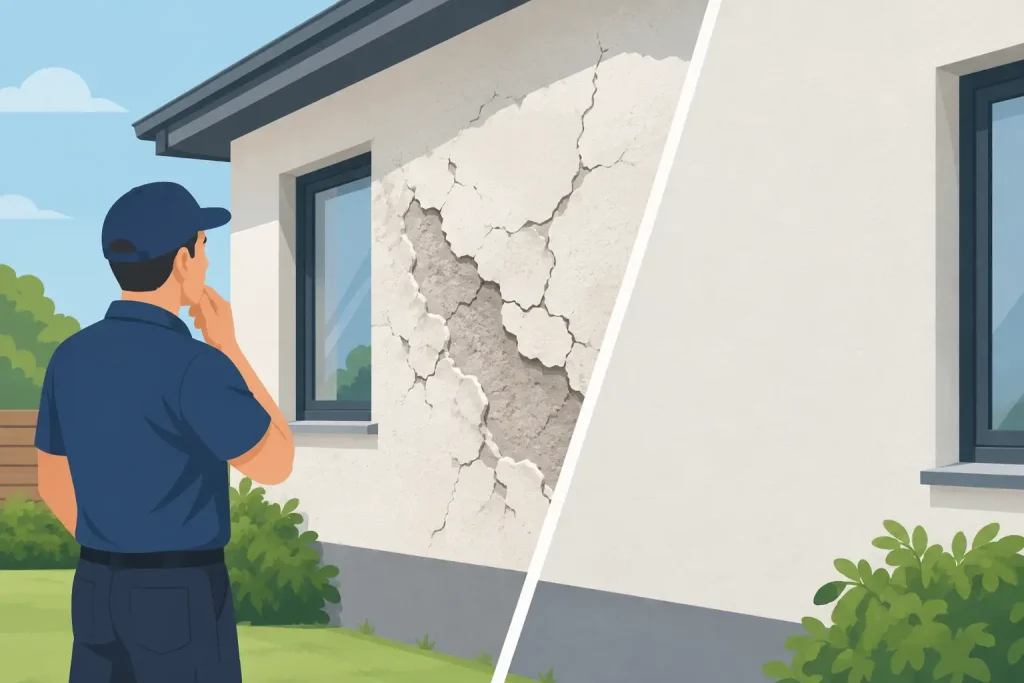
A small crack in exterior render is not always a reason to panic. But when cracks spread, sections sound hollow, damp patches appear inside or the finish begins to fall away, delaying the work can turn a surface problem into a more costly repair. Knowing when to replace render helps you protect the wall beneath it, improve the look of the property and avoid spending money patching a finish that has reached the end of its useful life.
Render is there to provide a protective, weather-resistant finish as well as improve kerb appeal. In the UK, it has to cope with driving rain, frost, heat, movement in the building and years of general wear. Even a well-applied render finish will not last forever. The key is working out whether the existing render can be repaired properly or whether removal and replacement is the sensible long-term option.
When to replace render rather than patch it
Minor damage can often be repaired. A small localised crack, a chipped corner or a small area damaged by an impact does not necessarily mean the whole elevation needs replacing. The surrounding render must be sound, firmly bonded to the wall and free from wider signs of moisture damage.
Replacement becomes more likely when faults are widespread or the render is no longer properly attached to the substrate. Patching over weak material may make the wall look better for a short while, but it will not stop further sections failing. It can also leave a visibly uneven finish, particularly on older properties where the original colour has weathered.
A proper site assessment is the best way to make that call. The render should be checked for adhesion, cracking patterns, moisture issues and the condition of the wall behind it. There is no point applying a fresh finish until the cause of the failure has been dealt with.
Clear signs your exterior render may need replacing
Cracks that keep returning
Hairline cracking can occur as a building settles or responds to temperature changes. It may be cosmetic, particularly if the cracks are very fine and isolated. However, cracks that are widening, branching across the wall or returning after previous repairs deserve closer attention.
Cracking around window openings, doors and changes in the building can point to movement. Cracks lower down the wall may be linked to impact damage or moisture. If water can get through the finish, it may freeze during cold weather, expand and force the crack wider. Treating the visible line alone will not be enough if the render behind it has already broken down.
Hollow or loose areas
Render should feel solid and well bonded to the wall. If tapping the surface produces a hollow sound, known as drummy render, it can indicate that it has detached behind the face. You may also notice bulging, movement when pressed or edges beginning to lift.
Loose render is a strong sign that replacement is needed in that area at minimum. Where hollow sections are scattered across a wall, removing the failed render and starting again is usually more reliable than carrying out multiple patches. Loose material can eventually fall, creating a safety issue as well as leaving the wall exposed.
Blown, bubbling or crumbling patches
Bubbles, blisters and soft or powdery patches suggest that moisture has got into the render or that the bond has failed. These problems are often seen on exposed elevations, around leaking gutters, below poorly detailed window sills or where rainwater regularly splashes back from the ground.
The source of water needs to be corrected before any rendering work is done. Re-rendering a wall beneath a leaking gutter simply repeats the problem. Once the wall has been allowed to dry and any defects have been resolved, the damaged material can be removed and the surface prepared correctly.
Damp marks inside the property
Not every internal damp patch is caused by failed render. Condensation, plumbing leaks and roofing defects can all be responsible. Still, a damp patch that sits on an external wall, especially where there is cracking or staining outside, should be investigated.
Damaged render can allow rainwater into the wall construction. You may see peeling paint, staining, a musty smell or plaster deterioration internally. Acting early is worthwhile, as prolonged moisture can affect more than the external finish. A careful inspection should identify whether the render is the problem and whether other repairs are needed first.
Staining, algae and a tired appearance
Surface dirt and algae alone do not mean you need new render. Shaded walls, trees and regular rain can leave a green or black build-up even where the render remains sound. Professional cleaning and appropriate maintenance may be enough.
However, staining alongside cracking, flaking paint, crumbling edges or persistent damp can be a sign of a finish that is no longer performing well. Older render may also look patchy after repeated repairs. If the property is being renovated or prepared for sale, replacement can give the exterior a cleaner, more consistent result than further spot repairs.
Why render fails before its time
Poor preparation is one of the most common reasons render fails. The background needs to be clean, stable and suitable for the system being applied. Weak surfaces, contamination, inadequate reinforcement or the wrong materials can all affect how well the render bonds.
Weather conditions also matter. Applying render in unsuitable temperatures, heavy rain or strong direct sun can cause drying and curing problems. The same is true where coats are rushed or applied at the wrong thickness. Good workmanship is not just about the final texture. It is about the preparation, materials and timing that make the finish last.
Movement in the property, leaking rainwater goods and poorly maintained seals around openings can also shorten the life of otherwise sound render. Before deciding on a replacement, it is worth looking at the whole elevation rather than treating the damaged area in isolation.
Repair, partial replacement or a full new finish?
There are three realistic options, and the right one depends on the condition of the existing surface.
A local repair suits a small, clearly defined defect where the surrounding render is solid. This is usually the least disruptive option, although matching an old texture or colour exactly can be difficult.
Partial replacement is appropriate where one section of an elevation has failed due to a local issue, such as water damage around an opening. The defective render is removed back to a sound edge, the underlying wall is repaired and the new finish is blended as neatly as possible.
Full replacement is often the better value choice where failure is widespread, the existing render is old and patched repeatedly, or the wall needs a complete change of finish. It costs more upfront than a small repair, but it avoids a cycle of call-backs and isolated patches. It also gives the opportunity to choose a modern exterior finish suited to the property and its exposure.
What happens during render replacement
A professional replacement job begins with protecting windows, paths, planting and nearby surfaces. Failed render is then removed carefully, with loose material taken back to a sound base. Any cracks, damaged masonry, water ingress points or unsuitable details are addressed before the new system is applied.
The preparation stage takes time because it determines the finish. Depending on the wall and chosen product, this may involve repairs to the background, a base coat, reinforcement where required and suitable primers. The final finish is then applied in controlled conditions to achieve an even appearance.
For homeowners, one of the biggest differences is choosing a contractor who explains what has failed and why. A quote should make clear whether it covers local repairs, removal of old render, preparation, the new finish and protection of the site. The cheapest price is not always the best value if key preparation work has been missed out.
Choosing a replacement finish
Traditional rendered finishes remain suitable for many properties, but they are not the only choice. A cork spray finish can be a practical alternative where homeowners want a flexible, textured exterior coating with added thermal and acoustic benefits. It can be particularly useful on properties where movement and weather exposure have made rigid finishes more prone to cracking.
The best option depends on the wall construction, the condition of the existing surface, the appearance you want and the property’s exposure to the weather. A finish should be selected for performance first, then colour and texture. It also needs to be applied to a properly prepared background by someone familiar with the system.
If you are unsure whether your render needs a repair or complete replacement, do not wait for loose sections or internal damp to make the decision for you. A straightforward assessment of the wall can show what is sound, what needs attention and the most sensible route to a finish that will look right and stand up to the weather.