
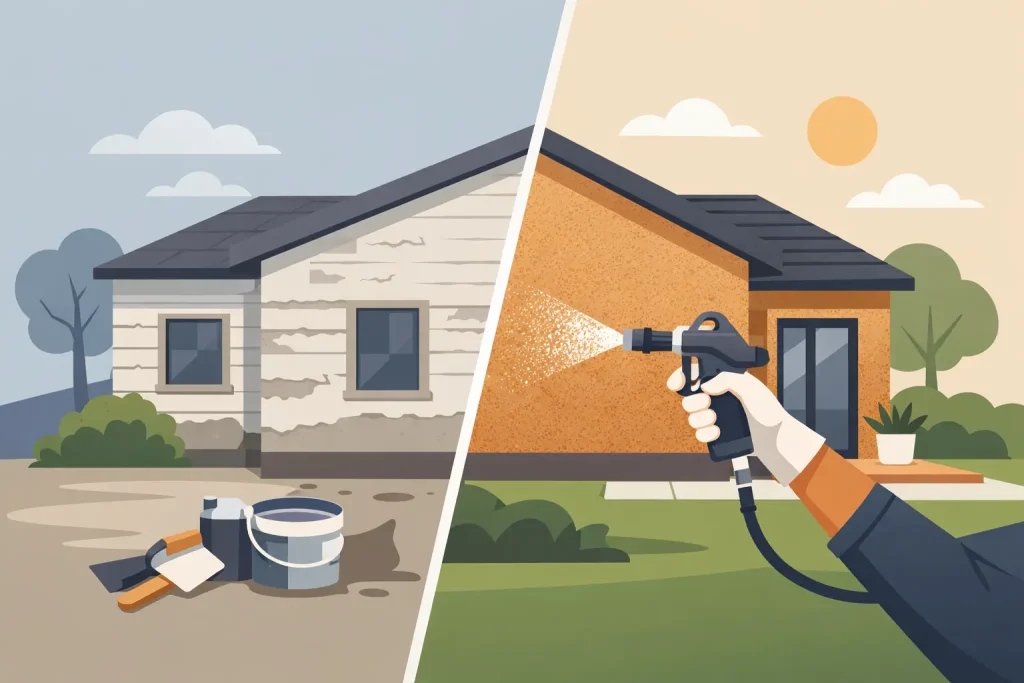
A property does not need to be falling apart to need attention. Often, the change starts with exterior render that looks tired, has patch repairs showing through, or has lost its even colour after years of weather. This cork spray house transformation example shows what can be achieved when the existing surface is assessed properly and the new finish is applied with care.
The aim is not simply to cover an old wall. A good cork spray finish can give a house a cleaner, more modern appearance while adding a flexible, water-repellent outer coating with useful thermal and acoustic properties. The final result depends heavily on the condition of the walls underneath and the preparation carried out before any material is sprayed.
The starting point: a weathered, uneven exterior
Imagine a typical rendered home with a mix of faded paint, hairline cracking and a few previous repairs around windows and corners. From the road, the property looks dull and neglected. Closer up, it is clear that some areas are sound while others need more work before they can accept a new coating.
This is a common situation with properties across Essex. Traditional render can become stained, crack around movement points or lose its neat appearance over time. Repainting may improve the colour for a while, but it does not deal with weak patches, poor adhesion or the underlying movement that caused the cracking.
At the survey stage, the key question is whether the existing render is firm and stable. Any hollow, loose or blown areas need removing. Cracks need opening out and repairing correctly rather than being filled over quickly. Downpipes, window edges, external lights and adjoining surfaces also need planning for, so the finished work has clean lines rather than overspray and rough edges.
A cork spray house transformation example, step by step
In this example, the property has sound render across most of the front and side elevations, but there are several failed repairs and fine cracks around openings. The homeowner wants a lighter, fresher finish that will stand up better to rain and changing temperatures than repeated coats of masonry paint.
The work begins with thorough protection. Windows, doors, paving, brickwork and roofline details are masked carefully. This part takes time, but it is what keeps the site tidy and gives the finished coating a sharp edge. A professional exterior job should improve the house, not leave the owner with splashes on their frames or patio.
Loose material is then removed, and the affected areas are repaired to create a stable base. The walls are cleaned to remove dirt, algae and surface contamination. Depending on the substrate, a suitable primer may be applied to help create a consistent background and support adhesion.
Only when the walls are dry, prepared and ready should the cork spray application begin. The coating is sprayed in controlled passes to build an even finish across the elevation. It has a fine, lightly textured appearance rather than the flat, painted look of many older rendered houses.
The difference is usually noticeable straight away. The patchy repairs disappear into a consistent surface, tired render takes on a uniform colour, and the property looks looked after again. Once the masking is removed and the surrounding areas are cleaned down, the transformation is often more striking than homeowners expect.
Why cork spray can suit an exterior renovation
Cork spray is not a cure for every external wall problem, but it can be a sensible option where the existing surface is sound enough to retain and the owner wants more than another coat of paint. Its elasticity can help it accommodate small amounts of movement better than a rigid finish. That does not mean significant cracks can be ignored, but it is useful on many rendered elevations that experience normal seasonal expansion and contraction.
The finish is also designed to be water repellent while allowing the wall to release moisture vapour. This balance matters. Trapping moisture behind a coating can lead to further problems, particularly where there are existing defects or poor detailing around sills, pipes and roof junctions.
Cork-based coatings can contribute to the thermal performance of the external surface, helping to reduce the cold feel of walls in some circumstances. However, it is important to be realistic. A sprayed cork coating is not a replacement for a full external wall insulation system where major insulation improvement is the priority. The likely benefit depends on wall construction, existing insulation, exposure and the condition of the property.
There can also be an acoustic benefit, although no responsible contractor should promise to eliminate outside noise. On a busy road, glazing, gaps around openings and the overall construction of the building all affect how sound travels indoors.
The finish is only as good as the preparation
The visible coating is the final stage of the job, not the whole job. Poor preparation is one of the main reasons exterior finishes fail early. Applying a quality product over damp, dirty, loose or unstable render is false economy.
A proper assessment should identify whether there are signs of water ingress, failed seals, damaged coping, defective guttering or cracks caused by a more serious issue. These need dealing with before the new finish is applied. If a wall has widespread failure, it may need more extensive repair rather than a coating applied over the top.
Weather also affects the programme. Exterior spraying needs suitable dry conditions and temperatures for the material being used. Rushing because a job has been booked into a wet or cold spell is not good practice. A reliable contractor will explain any necessary changes to the schedule rather than compromise the finish.
Choosing colour and texture for the property
For many homeowners, colour is the most exciting part of the transformation. A warm off-white can lift a traditional property without making it look stark. Soft greys often suit more contemporary homes, while muted stone shades work well alongside brick plinths, dark window frames and natural roofing materials.
It is worth viewing samples outside, not just indoors or on a phone screen. Daylight changes throughout the day, and nearby brickwork, landscaping and windows will influence how a colour appears. A lighter colour can make a compact property feel brighter, but it may show dirt more readily in exposed areas. A darker shade can look smart and practical, though it may make certain elevations feel heavier.
Texture should also be considered. Cork spray has a distinct fine-grain finish. It is not intended to imitate perfectly smooth painted render, and that is part of its character. The right choice depends on the style of the home and the owner’s expectations.
What homeowners should ask before booking
Before committing to any exterior renovation, ask what condition the existing render is in and how repairs will be handled. A clear quotation should set out the preparation work, areas included, protection measures, finish colour and any exclusions. If access equipment is needed, that should be discussed from the start rather than appearing as an unexpected extra.
It is also sensible to ask how long the work is likely to take and what access the team will require. Most homeowners want the job completed efficiently, but they also want their property respected while it is underway. Clean working practices, regular communication and careful masking are not optional extras. They are part of professional workmanship.
For landlords and renovators, a renewed exterior can also improve first impressions at viewings and make a property look properly maintained. That said, appearance should not be prioritised over necessary repairs. Addressing the cause of cracking or dampness first will protect the investment in the new finish.
A worthwhile change when the walls are ready
A well-planned cork spray transformation can take a house from worn and patchy to clean, even and properly finished without the disruption of removing every section of sound render. At Lee Crane Plastering incorporating Eco Corkspray Solutions, the focus is on assessing the walls honestly, preparing them properly and delivering a finish that looks right from close up as well as from the kerb.
If your exterior is looking dated, do not assume it needs another quick coat of paint. A site assessment can establish what is sound, what needs repairing and whether cork spray is the right route for a lasting improvement.