
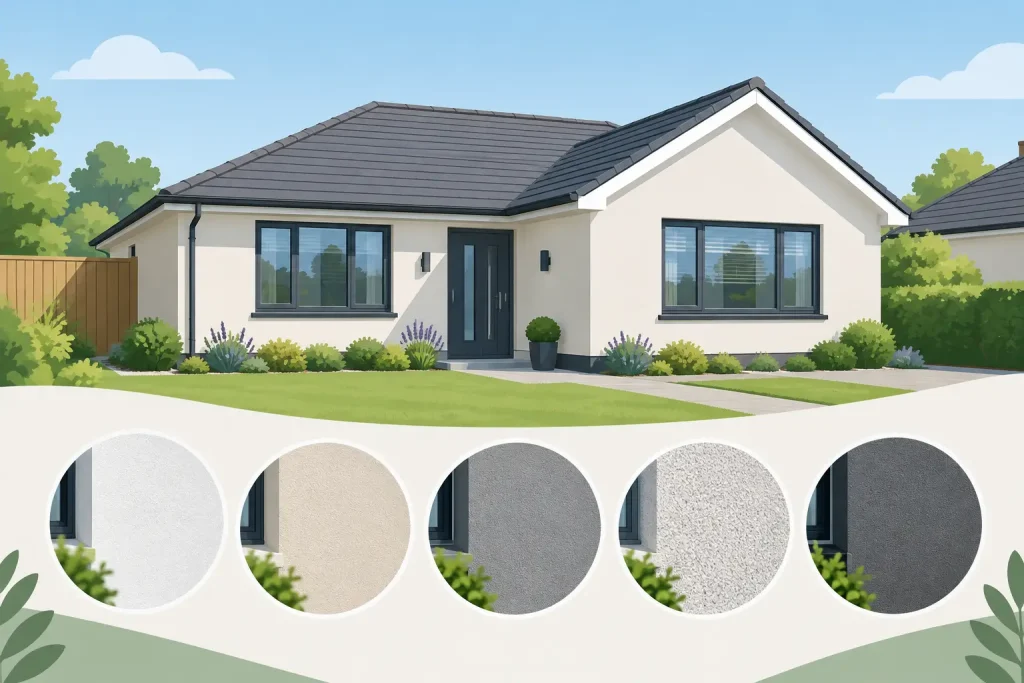
A bungalow can look tired very quickly when the external finish is cracked, stained or patchy. Its long, low walls are highly visible from the road, so the best render options for bungalows need to do more than cover old masonry. They need to suit the property’s construction, cope with British weather and provide a clean, even finish that will continue to look right for years.
There is no single render that suits every bungalow. The right choice depends on the condition of the existing walls, whether insulation is being added, the amount of exposure to rain and shade, and the look you want to achieve. A proper site assessment matters because a good finish starts with sound preparation, not simply applying a new coat over a problem.
What to consider before choosing a bungalow render
Bungalows often have large areas of wall beneath wide rooflines, with fewer breaks from upper floors or windows. This makes any unevenness, cracking or poor detailing more noticeable. It also means the colour and texture of the render have a bigger effect on the overall appearance of the property.
First, establish what is already on the walls. Old painted render, failing cement-based render, exposed blockwork and mixed repairs all need different preparation. Loose or hollow areas must be removed and repaired before a new system is considered. Covering poor material may look acceptable for a short time, but movement and moisture issues usually return through the new finish.
The property’s setting is just as relevant. A bungalow in an open, exposed position may need a more weather-resistant finish than one on a sheltered estate. North-facing walls, overhanging trees and areas close to the ground can remain damp for longer, making surface staining more likely. Good detailing around sills, pipework, roof edges and the base of the wall is as important as the render itself.
Colour is worth discussing early. Pale shades can make a low property feel brighter and larger, while a deeper grey or warm neutral can give a more contemporary appearance. Very dark colours can be less forgiving on large elevations, particularly where walls receive strong sun, so they should be chosen with the system and substrate in mind.
Best render options for bungalows
Silicone render systems
Silicone render is a popular choice for homeowners who want a modern, low-maintenance finish. It is usually applied as part of a specified system over a suitable basecoat and reinforcement mesh. The finished surface is decorative, water-repellent and breathable, helping rainwater run off while allowing water vapour within the wall to escape.
This type of finish works particularly well on bungalows because it provides a consistent fine texture across wide wall areas. It is available in a broad range of colours, so there is no need to paint it after application. A quality silicone finish is also less likely to hold dirt than many older render surfaces, although no external wall is completely maintenance-free.
The trade-off is that preparation needs to be right. Silicone render is not a cure for loose existing render, damp defects or failed detailing. It should also be applied in suitable weather conditions and as part of a compatible system, rather than mixing products without a clear specification.
Cork spray render
Cork spray is an excellent option where homeowners want a flexible, contemporary finish with practical benefits beyond appearance. Applied in several thin coats, it creates a textured, natural-looking surface that can suit both traditional and modernised bungalows. It is available in a range of colours and can give older properties a noticeably smarter, more uniform exterior.
One of its main advantages is flexibility. Bungalows can experience small amounts of movement over time, particularly around extensions, altered openings and repaired areas. Cork spray can help accommodate minor movement better than more rigid finishes, reducing the likelihood of fine cracking showing through. It also offers thermal and acoustic benefits, although it should not be treated as a replacement for a full insulation solution where substantial heat loss needs addressing.
Its textured finish is a matter of taste. Some homeowners prefer the smooth, fine-grain appearance of silicone render, while others like the softer texture and character of cork spray. The best choice comes down to the property, the condition of the walls and the finish you want to see every time you pull onto the drive.
Acrylic render
Acrylic render can provide a hard-wearing, coloured finish and is often considered for properties where impact resistance is a priority. It is generally more flexible than traditional rigid render and is available in different textures and colours. For a bungalow in a busy family setting, or where walls are more exposed to everyday knocks, it can be a practical option.
However, acrylic finishes tend to be less breathable than silicone alternatives. That does not automatically make them unsuitable, but it does mean the wall construction and existing substrate need careful consideration. On older homes, managing moisture properly should always take priority over choosing a finish simply because it is available in a preferred colour.
Traditional cement-based render
A traditional sand and cement render may still be appropriate for some bungalows, particularly where it matches existing work or the wall construction calls for a more conventional approach. When correctly mixed, applied and finished, it can produce a solid, tidy result.
It does have limitations. It is less flexible than modern systems, so movement cracks can be more likely over time. It will normally require painting, which brings ongoing maintenance, and poor application can leave a surface prone to shrinkage cracks or water penetration. It is rarely the best answer for simply covering tired walls without first dealing with the reason the original finish failed.
Should you add external wall insulation at the same time?
Rendering a bungalow is a sensible time to consider external wall insulation, especially where the property has solid walls or feels cold despite adequate loft insulation. The insulation is fixed to the outside of the building and then finished with a compatible render system. This can improve thermal performance while transforming the appearance of the home.
It is not suitable for every project. Window reveals, roof overhangs, external pipes, gates and boundary lines all need to be checked, as the wall thickness increases. The roof edge is especially important on bungalows. There must be enough projection to protect the new wall build-up from rain, or alterations may be required before the work starts.
For some properties, rendering without insulation is the sensible route. If the existing walls are sound and the main aim is to repair damage and improve kerb appeal, a well-specified finish may be all that is needed. The decision should be based on the building, budget and long-term plans for the property.
The preparation that protects the finished job
The visible topcoat is only the final part of a rendering project. Reliable work begins with checking the walls for cracks, hollow areas, failed paint, damp staining and weak backgrounds. Any underlying issue needs addressing before the new finish is installed.
Edges and junctions deserve close attention. Beads should be straight and properly fixed, mesh should reinforce areas that are prone to movement, and details around openings need to be neat. At ground level, the render should be kept clear of bridging damp protection and designed to avoid constant splashback. These details are easy to overlook, but they have a direct effect on durability and appearance.
A professional installer will also plan around the weather. Render should not be rushed in heavy rain, frost or unsuitable temperatures. Protecting fresh work while it cures helps prevent marks, weakness and uneven colour.
Choosing the finish that suits your home
For many bungalows, silicone render offers the cleanest low-maintenance appearance, while cork spray is a strong choice where flexibility, texture and added practical benefits are priorities. Acrylic may suit the right setting, and traditional cement-based render can still have its place where the building and specification call for it.
The best result is not the product with the boldest sales claim. It is the finish that is compatible with your walls, installed over proper preparation and detailed carefully from the roofline to the base of the property. If you are planning work on a bungalow in Braintree, Chelmsford, Colchester or the surrounding Essex area, a site assessment will give you clear answers before any work is priced or booked.